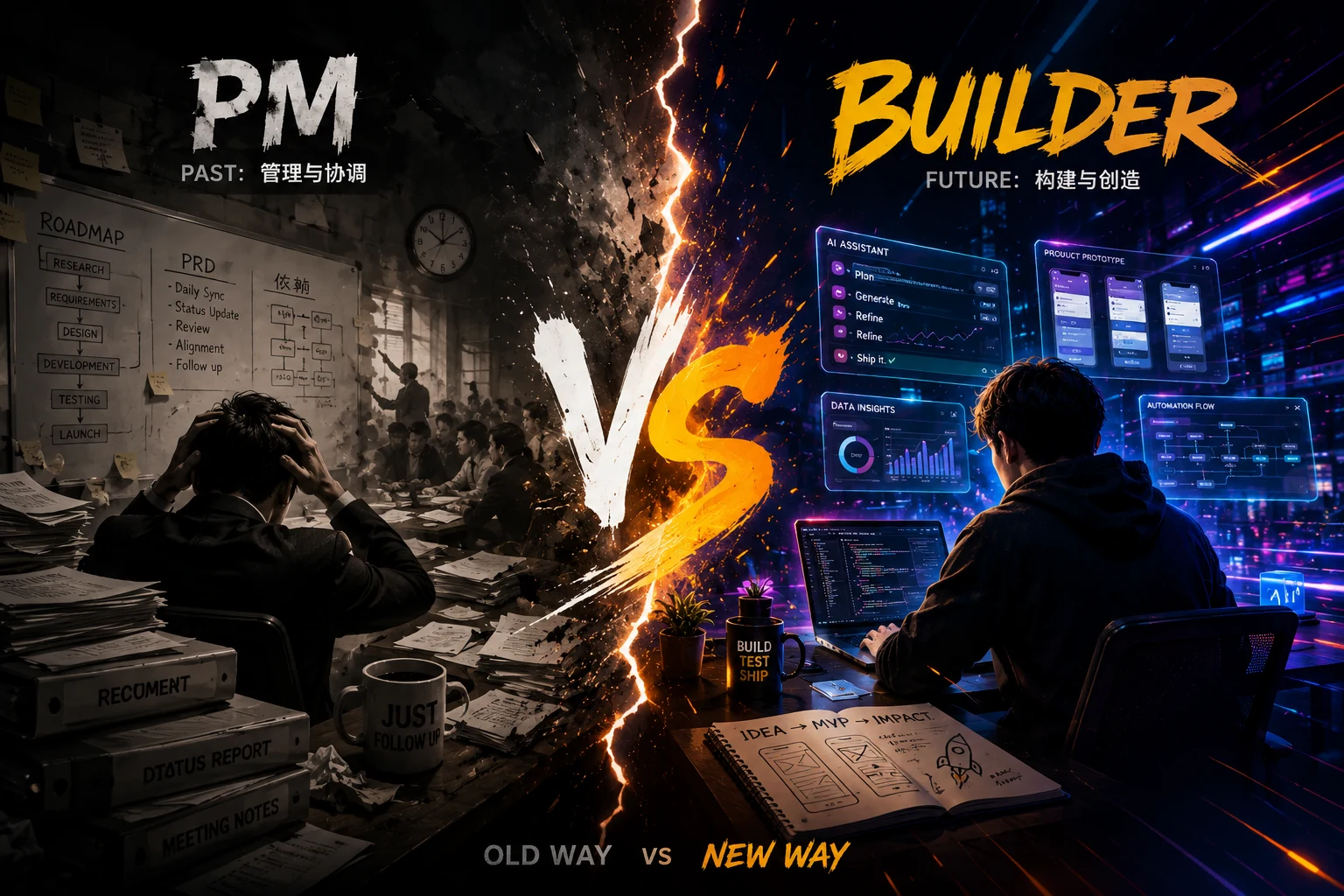
I have been watching a strange signal across Amazon, Meta, LinkedIn, and other large tech companies: the traditional PM, manager, and org owner are being redefined.
Amazon tested an org change inside Ring and Blink, calling some product-related employees Builders and managers Builder Leads. Meta has pushed AI-native pods inside parts of Reality Labs, with titles like AI Builder, AI Pod Lead, and AI Org Lead. LinkedIn changed its Associate Product Manager program into Associate Product Builder, emphasizing product, design, code, and AI tools together.
The signal is clear: the PM or manager who only coordinates, meetings, requirements, and other people's execution is being repriced.

1. From Controller to Builder
A lot of PM and manager value used to sit on top of org structure and information flow.
You did not necessarily build prototypes yourself. You did not necessarily analyze data yourself. You did not necessarily validate ideas yourself.
You stood in the middle: gathering requirements, coordinating design, arranging engineering, running meetings, pushing progress, and reporting upward.
That role did have value. Information transfer used to be expensive. Tools were harder. Execution resources were scattered. Turning an idea into a product often required designers, engineers, analysts, PMs, and a lot of scheduling.
The person in the middle mattered.
But after AI, how much of that value still holds?
Today, with Cursor, Claude, Codex, Replit, automation tools, and agent workflows, a strong individual can already run the first pass of work that used to require several roles.
You can write requirements yourself.
You can analyze data yourself.
You can generate pages yourself.
You can build a demo yourself.
You can validate an idea yourself.
In the past, saying I propose ideas and coordinate resources sounded powerful.
Now people ask a sharper question: did it land?
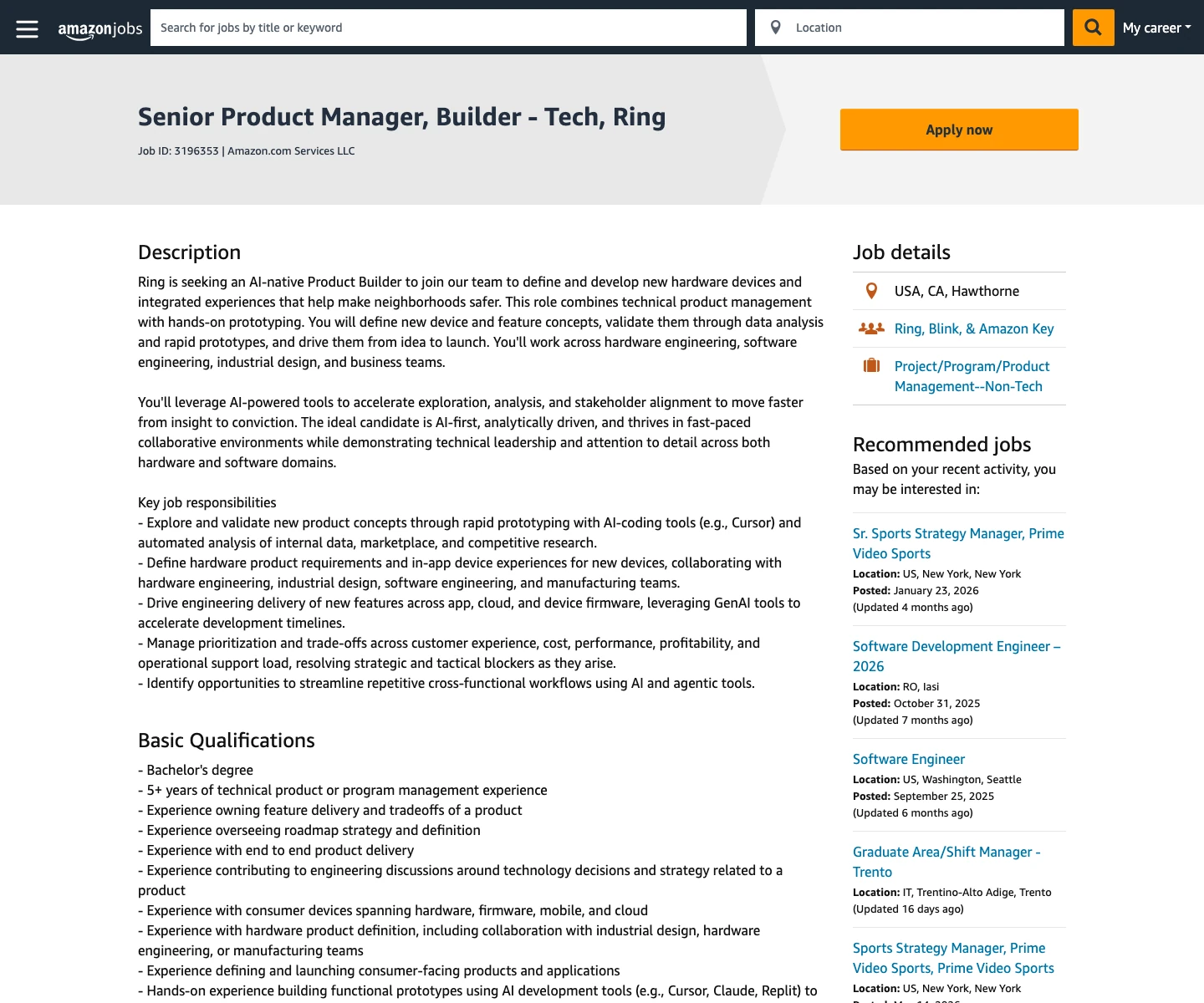
The Amazon job description still says Senior Product Manager, but then adds Builder - Tech.
That does not mean PM disappears. It means the PM capability stack has changed. You still need product judgment, but you also need to understand users and business. The description points directly to AI-native product building, hands-on prototyping, data analysis, rapid prototypes, AI-coding tools, and GenAI tools.
The old PM could easily imagine himself as the brain. I set direction, coordinate resources, and the team executes.
The more valuable PM will look more like a Product Builder: someone who can judge direction, get hands-on, understand the business, use tools, make the first version, explain the problem, and run toward a result.
2. The real issue is not unemployment. It is a higher bar.
Whenever people hear AI replacement, the anxiety is automatic.
Will there be no jobs?
Will ordinary people lose their place?
I do not see it that way.

This is history repeating. AI is raising the threshold.
When the spinning jenny appeared, it did not simply erase all work. It changed the labor structure. People who only relied on repetitive motion were hit. People who could master machines, understand process, and raise output found new room.
AI is similar. It does not instantly remove everyone. It makes low-density capability easier to replace.
What is low-density capability?
Writing documents without validating.
Running meetings without judgment.
Executing tasks without understanding the business.
Doing isolated tasks without producing results.
Waiting for assignments instead of using tools to solve problems.
Those abilities used to hide inside big organizations. Everyone was busy, so everyone looked necessary.
AI is a measuring stick. People who understand the business and can connect judgment, validation, building, and execution will be rewarded.
So the question is not whether AI will take your job.
The question is whether you can move from a single function into self-contained execution.
3. Self-contained execution is becoming the new entry bar
Over the next few years, job seekers, founders, and managers will all need one capability: self-contained execution.
This does not mean one person must do everything. It does not mean everyone becomes a full-stack engineer.
It means this: when you face a fuzzy problem, can you run the first round of judgment and validation yourself?
If you see a product opportunity, can you make a demo first? If you think of a growth idea, can you test it small? If you doubt a channel, can you pull data, analyze it, and reach a conclusion? If you want to improve a process, can you use AI to build a first automation?
A coordinator says: I need to get engineering, design, data, and operations into a meeting. A Builder says: I will use AI to make a demo, pull the data, run a validation pass, and then decide whether this deserves more resources.
The default configuration of talent is changing.
4. LinkedIn changing APM is really about organization design
Amazon's signal appears inside job titles. LinkedIn's signal appears at the talent entry point.
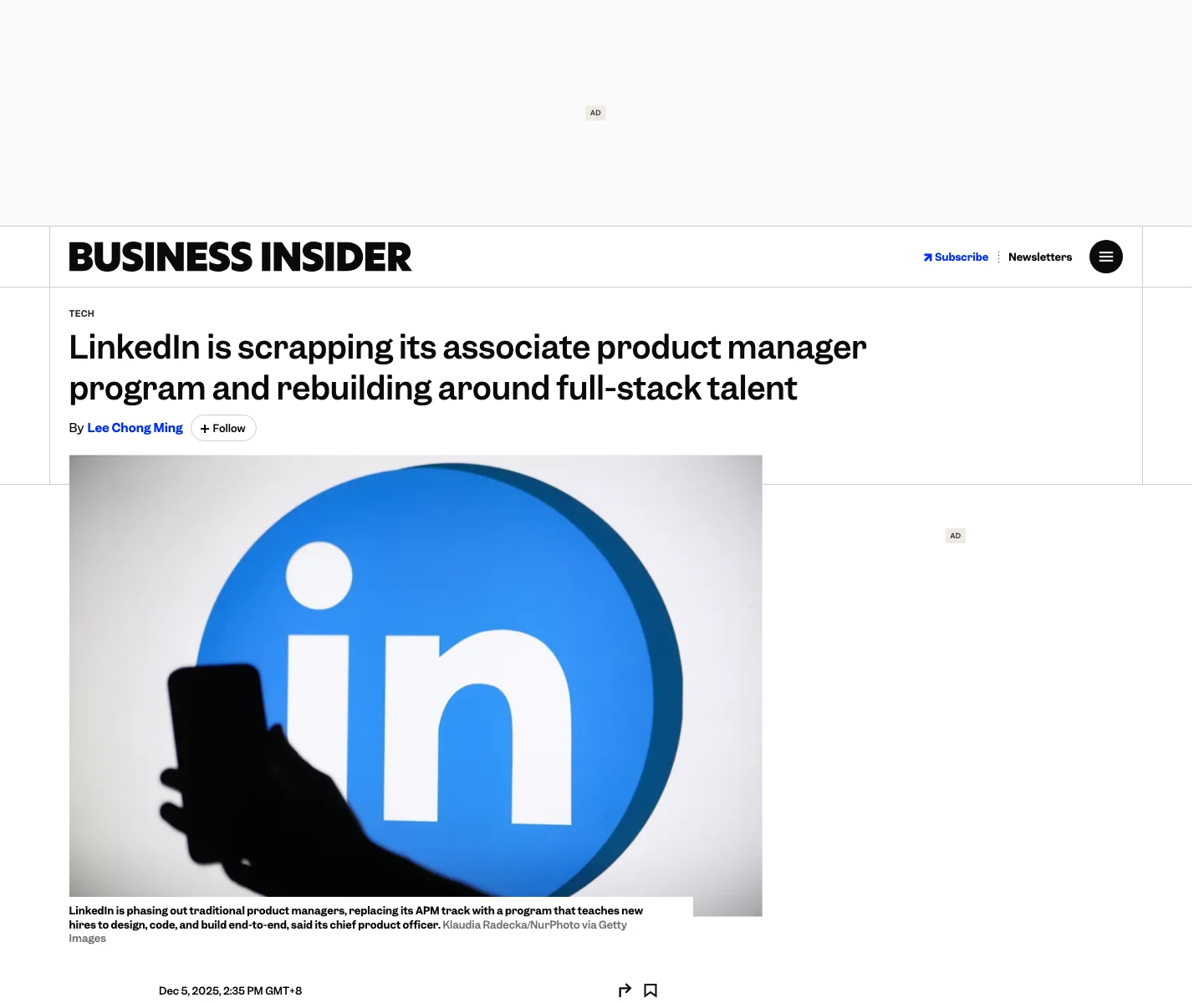
APM used to be one of the classic PM paths. In large tech, it almost represented the standard training system for product talent. LinkedIn changing APM into Associate Product Builder is not a cosmetic change. It pushes code, design, product management, and end-to-end building into the same frame.
The next generation of product talent is no longer being trained as pure functional PMs.
You cannot only write user stories, PRDs, priority lists, and coordination notes. You need to understand the chain: product, design, code, AI tools, validation, and result.
This also means company organization will move from function-oriented toward result-oriented.
A content team will be judged by conversion, trust, and acquisition cost. An SEO team will be judged by visibility across search, AI recommendations, and answer systems. An influencer team will be judged by off-site trust and real purchase paths.

When work is organized by function, people can hide behind boundaries. Ask about result, and someone says that is not my job. Ask about conversion, and someone says I only do SEO. Ask about business, and someone says I only do product.
When work is organized by result, many excuses disappear.
This is why Builder Lead is worth watching. A real Builder Lead defines the problem, judges priority, runs the first version, and then helps the team scale what works.
5. What becomes the new currency for job seekers?
I saw a creator on Douyin build a piece of hardware for making music through vibe. You tell it the rhythm and feeling you want, and it gives you something you can keep modifying.
Music creation, recording, post-production, visuals, and publishing used to depend on equipment, software barriers, teams, and specialized steps. Now one person can compress several roles into a first working version with AI, code, and automation.
Specialization will not disappear, but professional boundaries will be redrawn.
The stronger person is not always the person best at one isolated step. It is the person who can connect tools, stages, and feedback.
That is the new currency.
First: attention
AI tools are getting stronger, but human attention is getting more fragmented. Many people already have powerful tools and still lose every day to short videos, social feeds, and scattered information. They do not lose because they cannot use AI. They lose because they cannot stay with one thing long enough.
Second: depth of AI usage
The gap between people who use AI well and people who do not will become like the old gap around computers, search engines, and Excel.
The value is not saying you know ChatGPT. The value is using AI to build workflows, prototypes, analysis, automation, and turn ideas into testable results quickly.
The most dangerous person in the AI era is not the person who is lazy. It is the person still hiding inside the old division of labor.