On June 3, 2026, Stephen Curry posted the official partnership video with Li-Ning on Instagram.
My first reaction was excitement. Very personal excitement.
I started watching the NBA in 2015.
That was also when Curry and the Warriors began to change the league.
Threes, spacing, the Warriors dynasty, Steph, Klay, and Draymond. Those things ran through a large part of my teenage years.
I have also been a sneaker guy for a long time.
I bought almost every generation of Curry's signature shoes under Under Armour.
Over the years, I have bought more than a hundred pairs of basketball shoes.
I watched Chinese basketball shoes go from being questioned, rarely seen on courts, to becoming common across outdoor courts, campuses, and performance reviews.
Li-Ning stands out in that change.
In the past, when many people heard Chinese basketball shoes, they thought outlet products, weak performance, or cheap alternatives.
Now, if you go to a court, you see more and more Li-Ning shoes.
Way of Wade, All City, Yushuai, Sonic, and now Gamma. Li-Ning has moved from a value-for-money discussion into conversations about design, tech, feel, performance, and cultural style.
So Curry signing with Li-Ning hit three parts of me at once
the basketball fan, the sneakerhead, and the person watching Chinese brands change
Why did Curry leave UA?
After the excitement, the real question was this: why would Curry sign with Li-Ning?
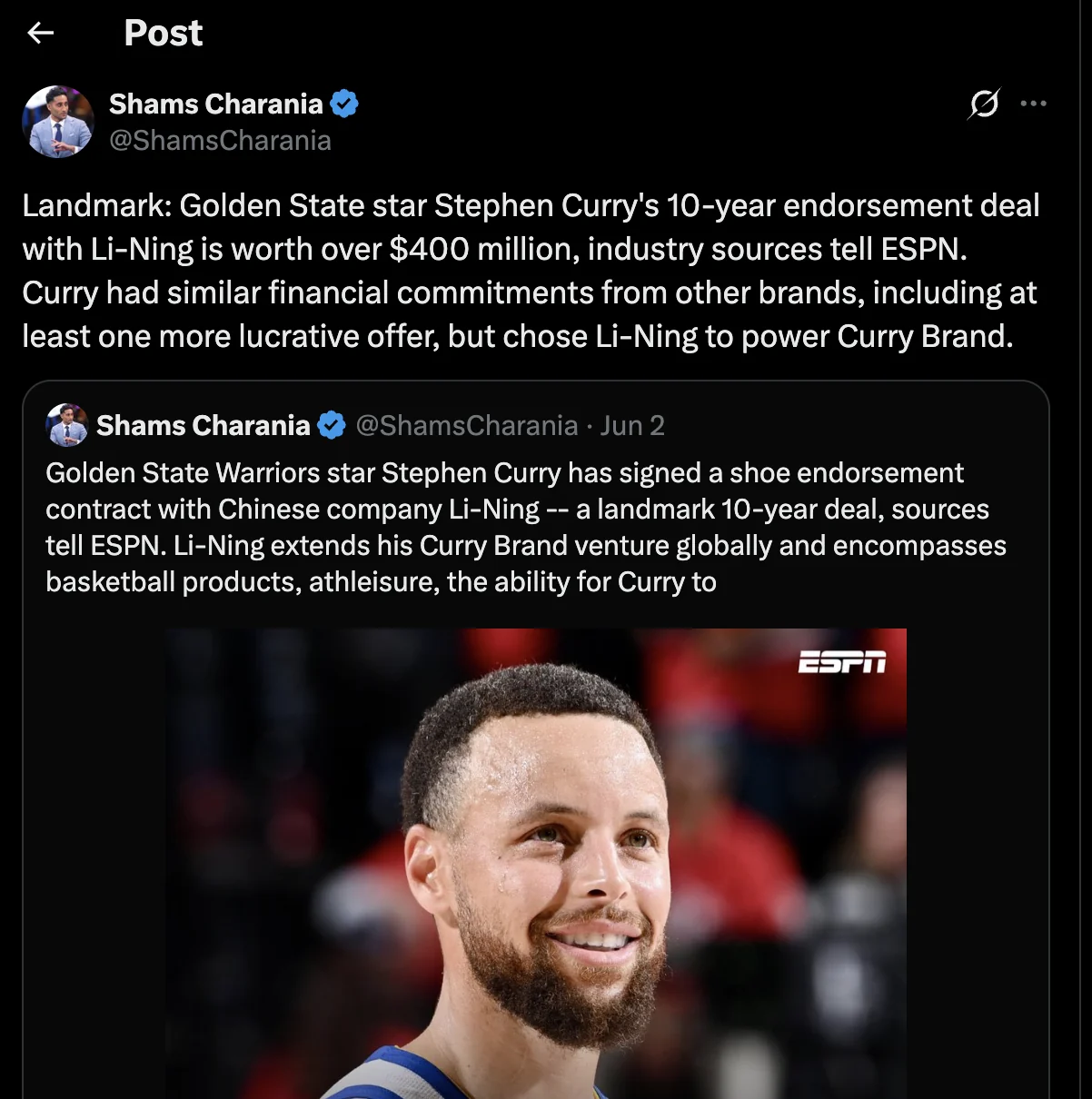
According to the Shams / ESPN reporting frame, the deal is for 10 years and worth more than 400 million dollars.
Within the scope of Chinese brands signing a single athlete's personal brand
this should be the highest publicly reported deal so far
Money matters, of course.
But money is only part of it.
Curry leaving UA reveals a clear problem
UA and Curry Brand no longer feel fully aligned
When Curry rose quickly, he pulled UA directly into the basketball conversation.
MVPs, championships, the three-point revolution, the Warriors dynasty. Curry's rise was so fast that UA enjoyed the lift.
But UA as a brand has always felt closer to training, gym culture, and athletic lifestyle.
It feels like a brand worn by people who care about workout gear, quality, and training scenes.
It has quality. It has sport. But its native basketball feeling has never been that strong.
Curry is different.
His biggest asset has always come from the basketball court: shooting, spacing, guard play, the Warriors system, and a generation of people copying his release.
Curry Brand increasingly looks like an independent basketball brand. It needs a deeper basketball product line, stronger court culture, more consistent shoe stories, and a partner willing to treat basketball shoes as the main battlefield.
That is where the tension between Curry Brand and UA appears.
You can even see the split in the financial context.
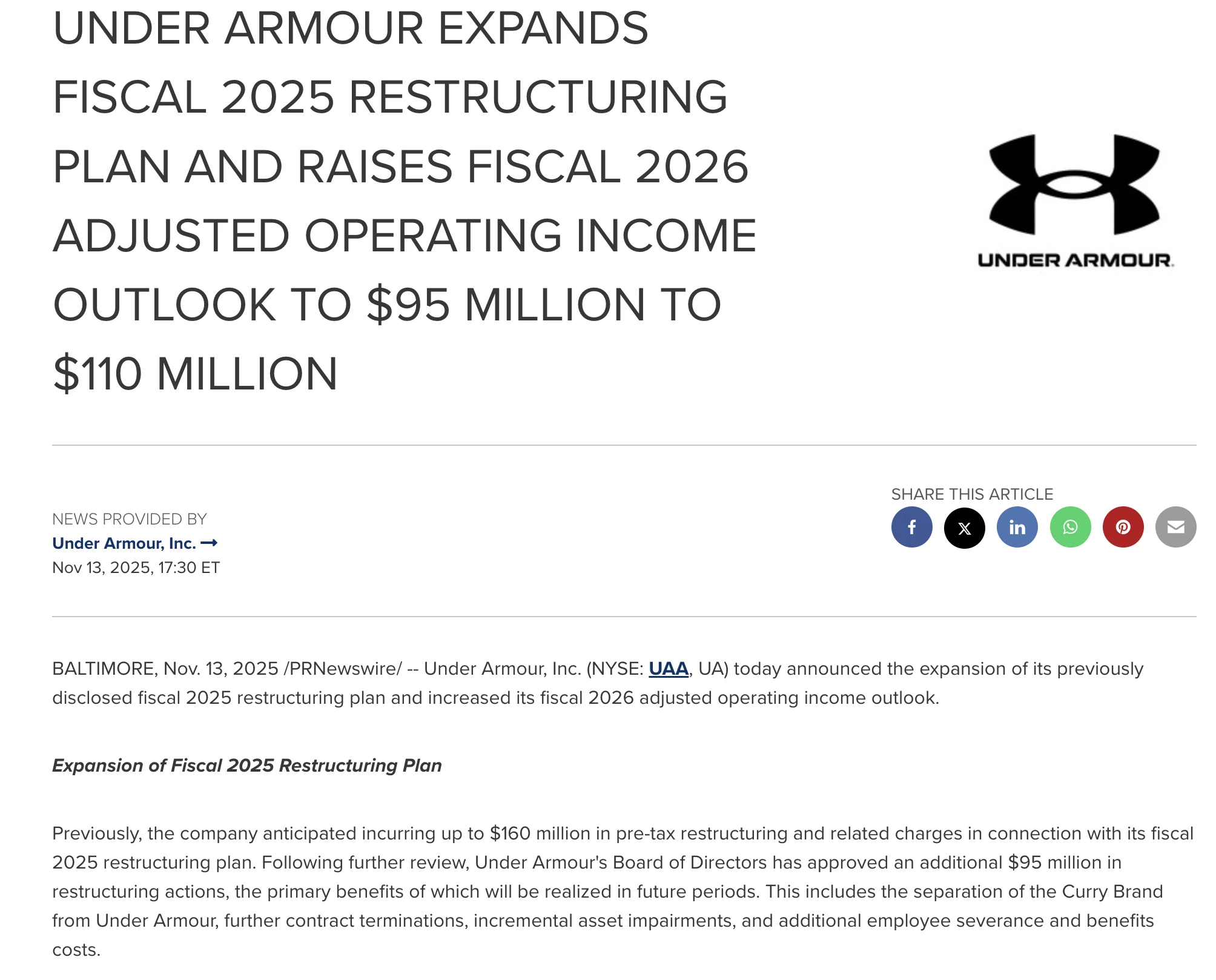
In the fiscal 2025 restructuring plan, UA placed the separation of Curry Brand inside a broader company-level adjustment.
It also said global basketball, including Curry Brand, was expected to generate only about 100 to 120 million dollars in fiscal 2026 revenue.
For a brand once pulled into basketball discussion by Curry, that scale is awkward
It suggests basketball was not UA's next core battlefield
At least not in a way that matched Curry Brand's expectations
Why Li-Ning?
The key point is that Li-Ning has genuinely gone deep into basketball.
Li-Ning is not suddenly trying to borrow a top star.
It has been building basketball shoes for years.
From Way of Wade to All City, Yushuai, Sonic, and Gamma, Li-Ning has treated basketball shoes as a real main line.
More importantly, Li-Ning basketball products already occupy user mindshare.
There used to be fewer Chinese shoes on court. Now it is completely different.
On many courts, Li-Ning and Anta are common. Li-Ning's presence is especially visible.
That means Li-Ning already has products, series, court users, and real feedback in the vertical basketball scene.
If Curry only wanted a bigger commercial number, there would be many options.
But if he wants to push Curry Brand further as a basketball brand, Li-Ning starts to make sense.
It is not a generic sports brand casually adding a basketball line
It has already earned presence inside the specific basketball shoe scene
That is why Curry's video becomes more interesting.
He did not frame the partnership as one shoe, or simply as another signature line.
He talked about where Curry Brand goes next, and who moves with it.
He mentioned quality products and sneakers that I believe in.
He also deliberately brought in Mr. Li Ning himself.
That matters.
Li-Ning was built from Li Ning's own name. It carries the athlete, national memory, competition history, and a personal symbol from the beginning.
Curry Brand works in a similar way. Curry's name carries play style, championships, shooting, family image, belief, and more than a decade of fan memory.
The smoothest part of this deal is the brand DNA
Li Ning is a person becoming a brand
Curry is a person continuing to turn his name into a brand
Two names standing together are more convincing than a simple shoe contract
Where do brands go next?
As someone working around cross-border commerce and brand marketing, this is the bigger question I keep thinking about.
Brands will increasingly depend on scenes
Which scene do you belong to, and which group of people believes you? That will matter more and more
UA feels closer to training, fitness, and athletic lifestyle.
Li-Ning is becoming a brand serious basketball shoe players actually pay attention to.
Curry's core asset is also basketball.
So Curry Brand moving from UA to Li-Ning is also a move from a broad sports scene toward a more vertical basketball scene.
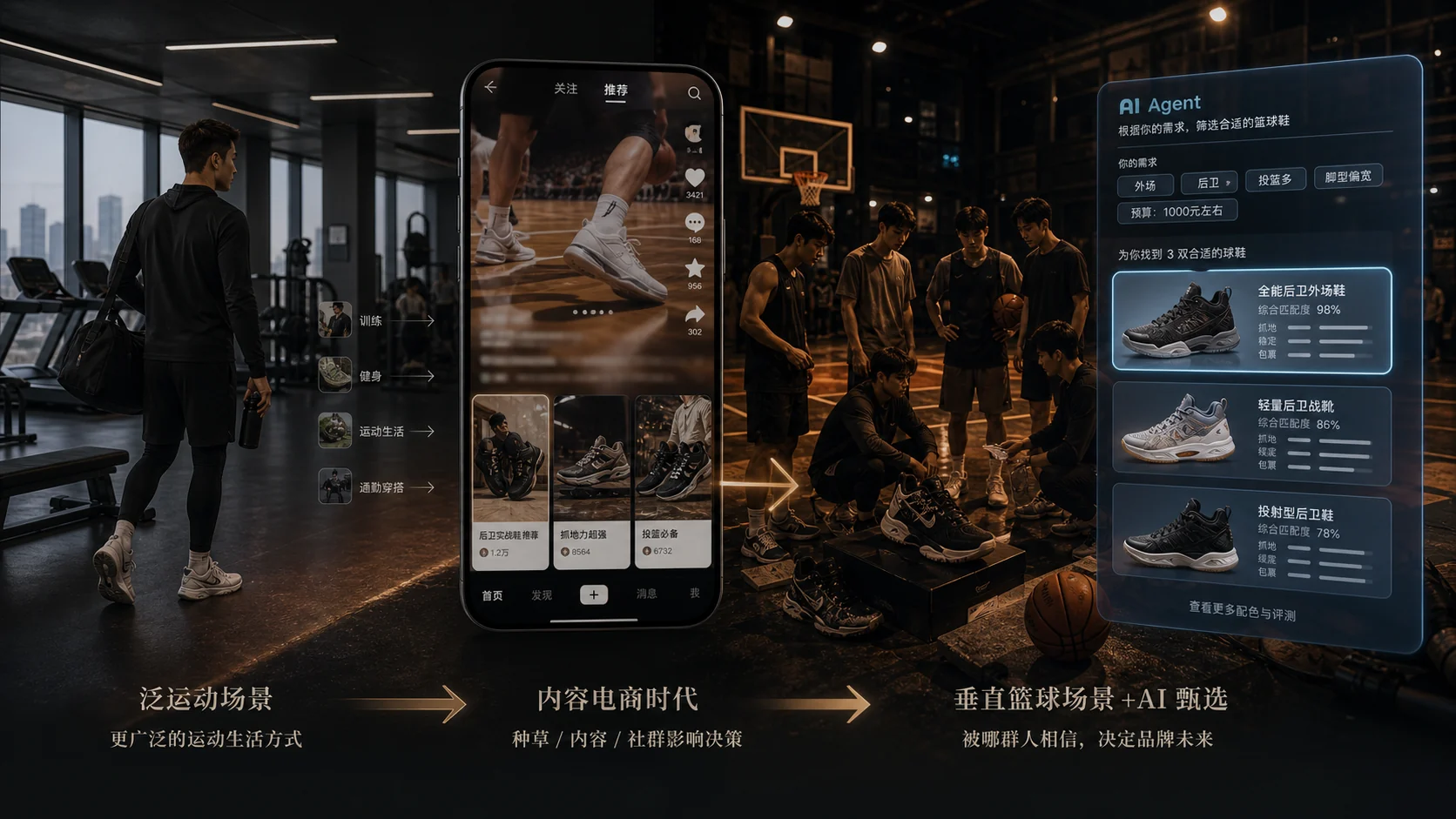
The entrance to commerce keeps changing.
The earliest online commerce logic was shelf commerce. Taobao and Amazon are both shelf systems at the core. Users enter with demand, search keywords, compare price, volume, reviews, and detail pages.
Then Xiaohongshu and Douyin pushed content commerce into the mainstream. Users do not always search first. They are planted by content, moved by scenes, influenced by people, and then enter a purchase path.
From shelf to content, the relationship between brand and user has already changed once.
The next change, I think, will likely happen inside AI and agents.
A user who wants basketball shoes may not open a marketplace and search slowly. He may tell his AI: I want outdoor basketball shoes for a guard, a lot of shooting, wide feet, around 1000 RMB.
Then the system filters first.
The question becomes: who does the system think of first?
A product with good parameters but no memory?
A cheap product with no identity?
Or a brand repeatedly worn, discussed, trusted, and remembered inside that vertical basketball scene?
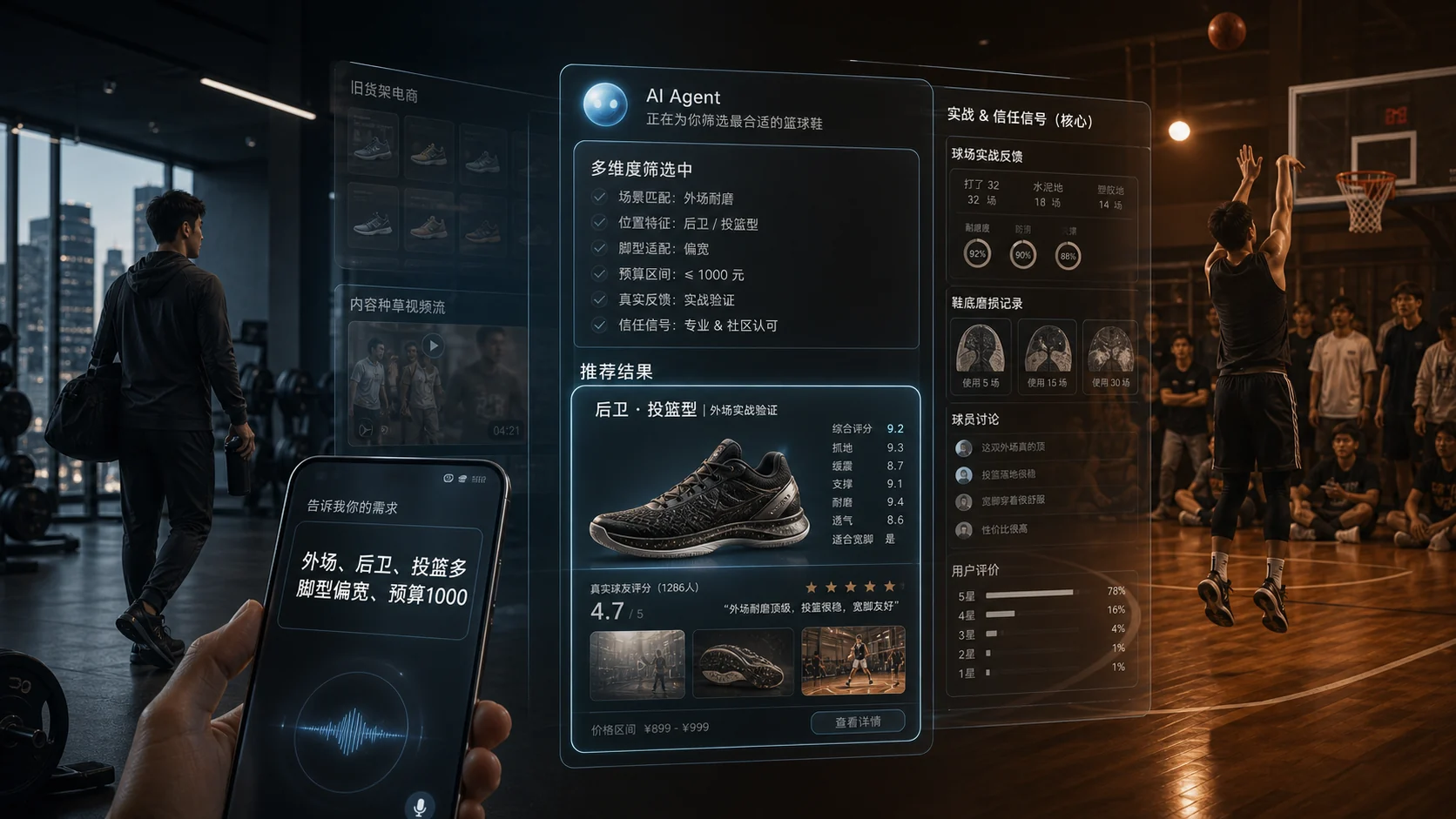
Many companies used to win through supply chain, channels, price, media buying, and distribution.
But if the consumer entrance moves from shelf and content toward agentic recommendation, brand verticality will become more important.
Which scene trusts you?
Are you a clear name in that category?
Do your products and your people have a long-term relationship?
Those things may decide whether you enter the AI's first candidate set
So after Curry put on Li-Ning, Chinese brands really did reach the next table.
But this table is not only about sports marketing, not only about signing a superstar, and not only about spending a lot of money.
It is a reminder to Chinese brands: just making goods may not be enough anymore.
People need to remember who you are.
Agents may also need to know which scene you belong to.
If commerce really moves into an Agentic Commerce era, brand, trust, and vertical scenes may reorder a new group of companies.
How long will that transition take?
We will see